Have you ever noticed how some dairy makes your stomach sing with joy, while others leave you feeling heavy and uncomfortable? There's a reason for that, and it lives in something as small as a single amino acid.
Here's what most people don't know: not all milk proteins are created equal. The ghee you drizzle on your morning toast could either support your body's natural rhythms or quietly work against them. And it all comes down to whether you're getting A2 beta-casein or its more troublesome cousin, A1.
If you've been wondering why A2 beta-casein milk is creating such a buzz in wellness circles, or why your grandmother swore by desi cow ghee, you're about to understand the beautiful science behind tradition.
What Exactly Is A2 Beta-Casein Protein?
Think of milk proteins as a family tree. A2 beta-casein is the original ancestor, the one that's been around since cows first gave milk. It's also the protein found in human breast milk, which tells you something about how our bodies recognize it.
About 5,000 to 10,000 years ago, a genetic mutation occurred in some European cattle. This created A1 beta-casein, which now dominates most commercial dairy. But indigenous breeds like the Gir cow? They kept the original genetics intact, continuing to produce pure A2 beta-casein protein.
The difference between these two proteins comes down to position 67 in their amino acid sequence. A2 has proline sitting there, while A1 has histidine. Sounds technical, but this tiny swap changes everything about how your body processes dairy.
When you drink milk with A1 protein, digestive enzymes can break the bond between histidine and the neighboring amino acid. This releases a peptide called beta-casomorphin-7, or BCM-7 for short. Research published in various nutritional studies suggests this peptide could interact with your gut in ways that might trigger inflammation.
But with A2 beta-casein milk? The proline bond holds strong. BCM-7 doesn't form in significant amounts, and your digestive system gets to work without interference.
The Real Difference Between A2 and A1 Beta-Casein
Let's break this down in a way that actually makes sense for your kitchen and your body.
|
What We're Comparing |
A2 Beta-Casein |
A1 Beta-Casein |
|
That crucial 67th position |
Proline (the gentle one) |
Histidine (the troublemaker) |
|
BCM-7 release during digestion |
Minimal to none |
Potentially significant |
|
How your gut might feel |
Comfortable, calm |
Could trigger discomfort |
|
Where you'll find it |
Gir, Sahiwal, Guernsey cows |
Holstein, Friesian, most commercial dairy |
|
Historical timeline |
The original form nature created |
Appeared after genetic mutation |
Here's what happens in your body: when A1 protein meets your digestive enzymes, that histidine bond breaks apart easily. The result? BCM-7 floating around in your intestines, potentially binding to opioid receptors in your gut lining. Some research indicates this could contribute to inflammation, digestive upset, and that bloated feeling you get after a glass of regular milk.
With A2, that proline bond stays put. Your body breaks down the protein into simple amino acids without creating BCM-7. It's dairy the way nature originally designed it, before modern breeding prioritized milk volume over protein quality.
Why Gir Cow Ghee Stands Apart
Now we arrive at the heart of the matter: Gir cow ghee and why it might be one of the gentlest dairy products you can bring into your life.
Gir cows are indigenous to India, descended from ancient Zebu cattle that naturally carry the A2 gene. They're not the high-volume milk producers you'll find in industrial dairies, they give less milk, but what they give is pure A2 beta-casein milk. When this milk is transformed through the traditional Bilona method, something almost magical happens.
The Bilona process isn't rushed. Fresh milk becomes yogurt overnight, cultured with natural bacteria. In the quiet of early morning, this yogurt is hand-churned: clockwise, then counterclockwise, until butter separates from buttermilk. That butter is then gently heated until it transforms into golden ghee, rich with the aroma of tradition.
This method does more than preserve nutrients. It removes the milk solids, lactose, and casein proteins, leaving you with pure butterfat that's been revered in Ayurveda for thousands of years. And because it started with A2 beta-casein protein, you're getting ghee that your ancestors would recognize, ghee that your body might process with ease.
Why It May Not Trigger Inflammation
Let's talk about what makes this ghee different from what sits on most grocery store shelves.
First, there's no BCM-7 to worry about. Since Gir cows produce only A2 milk, that inflammatory peptide never enters the equation. Your gut receives nourishment without the potential irritant that recent research has linked to digestive inflammation.
Then there's butyric acid, a short-chain fatty acid that ghee naturally contains. Your intestinal cells actually use butyrate as their primary fuel source. When you consume ghee rich in butyric acid, you could be supporting the very lining of your gut, potentially calming inflammation rather than causing it.
The high smoke point matters too. At 485°F, ghee remains stable when heated, unlike many oils that break down and create harmful compounds. You're cooking with a fat that doesn't turn against you at high temperatures.
And the nutrient profile? Vitamins A, D, E, and K arrive in fat-soluble forms your body can actually use. There's conjugated linoleic acid (CLA), which studies suggest might have anti-inflammatory properties. There are omega-3 fatty acids to help balance your body's inflammatory response.
Perhaps most importantly, the clarification process has already removed lactose and casein proteins. Even if you're sensitive to dairy, ghee, especially A2 Gir cow ghee, might be one form you can tolerate beautifully.
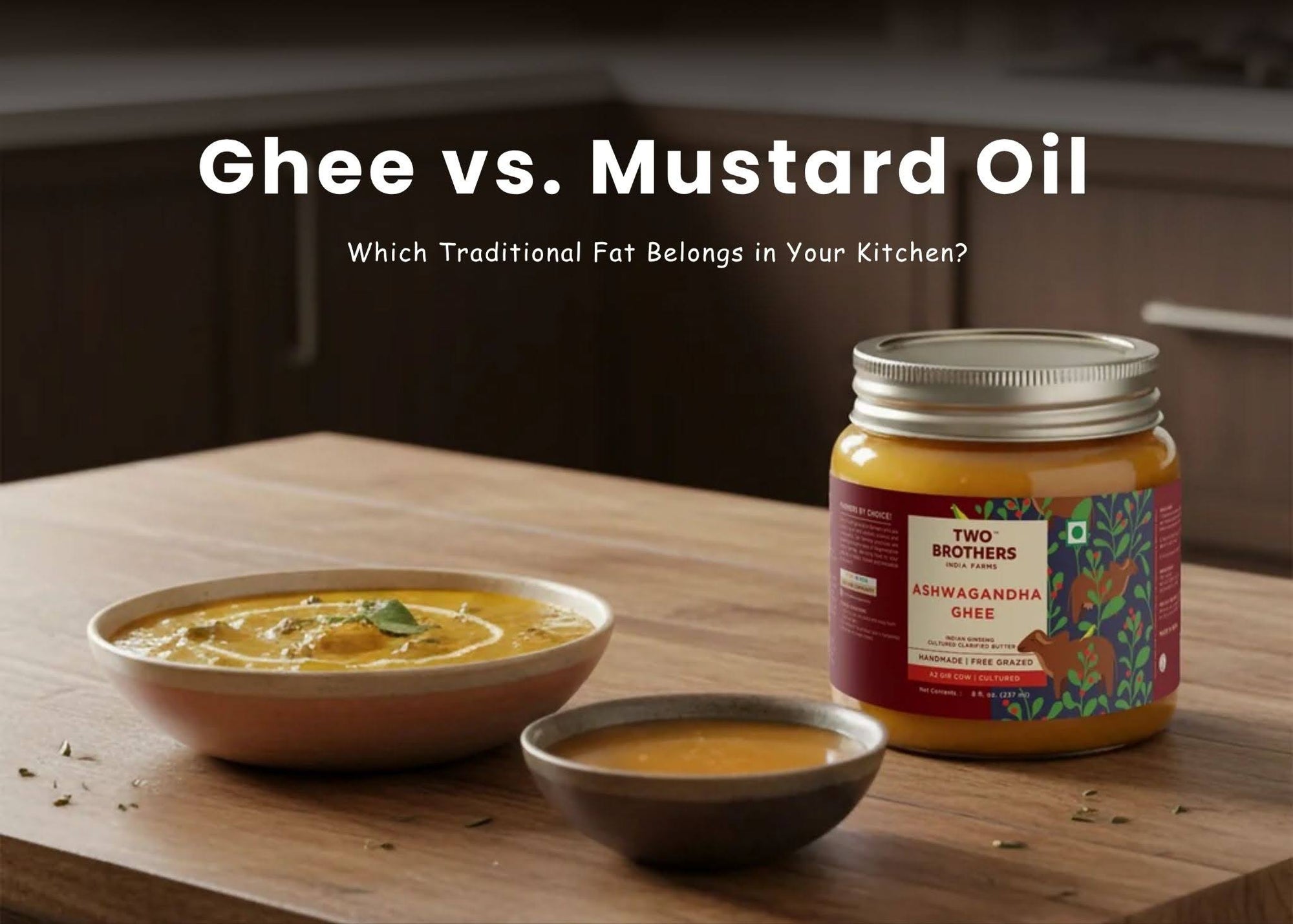
If you're curious to experience this difference firsthand, Two Brothers Organic Farms crafts their A2 Gir Cow Cultured Ghee using exactly this traditional method, from pasture-raised cows eating glyphosate-free feed.
What Research Tells Us About A2 Beta-Casein Benefits
Science is finally catching up to what traditional cultures have known for millennia. While we need to be careful about making absolute claims, the research emerging around A2 beta-casein benefits is genuinely fascinating.
Several studies have observed that people drinking A2 beta-casein milk report less digestive discomfort compared to regular milk. They experience less bloating, less gas, and fewer of those uncomfortable moments that make you regret your dairy choices. One review of dairy protein research found that individuals with lactose intolerance actually tolerated A2 milk better, suggesting the protein type matters as much as the sugar content.
There's also interesting work being done around inflammation markers. Some studies have found lower levels of inflammatory compounds in people consuming A2 versus A1 dairy. Animal research has shown reduced intestinal inflammation with A2 proteins. And when researchers look at gut microbiome changes, A2 milk seems to support a healthier bacterial balance.
Even cognitive function has been studied. Some preliminary research suggests that A2 milk might support better processing speed and mental clarity compared to A1, possibly because your gut-brain axis isn't dealing with BCM-7 interference.
Of course, everybody is different. What works beautifully for one person might not make a difference for another. But the growing body of evidence suggests that A2 beta-casein protein deserves serious attention from anyone interested in reducing inflammation and supporting digestive health.
Bringing A2 Ghee Into Your Daily Rhythm
The beauty of ghee is how effortlessly it fits into life. You don't need to completely overhaul your routine, just make one small, golden swap.
Start your morning with a teaspoon stirred into warm water or turmeric milk. This simple ritual could support your digestion before you've even had breakfast. Some people swear it gives them sustained energy that coffee alone never quite achieved.
In the kitchen, use it anywhere you'd normally reach for butter or oil. Sauté your vegetables in it, roast sweet potatoes, scramble eggs. The high smoke point means you're not creating oxidative stress while you cook, and the rich, nutty flavor transforms even simple dishes into something special.
If you're into bulletproof coffee or any kind of fat-fueled morning drink, blend in a spoonful of A2 Gir cow ghee. The healthy fats could help slow caffeine absorption, giving you energy without the jitters.
For those who grew up with South Asian food, you already know the comfort of ghee drizzled over dal and rice or melted into fresh roti. That's not just tradition, it's wisdom about making nutrients more bioavailable and food more satisfying.
And here's something your great-grandmother might have done: use it topically. Massage into dry skin or hair ends. The same fatty acids that nourish you from the inside can work their magic on the outside too.
When you're ready to experience what authentic, traditionally-made A2 ghee can do, explore Two Brothers Organic Farms' complete ghee collection, crafted in small batches, free from additives, and certified glyphosate-free.
The Bigger Picture: Why This Matters
Choosing A2 beta-casein milk products isn't just about personal health, though that's certainly important. It's also about supporting farming practices that honor animal welfare, genetic diversity, and traditional wisdom.
Indigenous breeds like Gir cows aren't high-volume producers. They're not the breeds that maximize dairy industry profits. But they're the breeds that have evolved over thousands of years to thrive in their environments, eating what grows naturally, living as cows are meant to live.
When you choose ghee from these animals, you're voting with your dollars for a different kind of agriculture. One that values quality over quantity, tradition over industrial efficiency, and the long-term health of both land and animals.
You're also preserving genetic lines that might otherwise disappear. As industrial dairy focuses on a handful of high-producing breeds, these indigenous cattle, along with their natural A2 genetics, become increasingly rare. Supporting them means supporting biodiversity.
And on a purely practical level, you're choosing food that your body might actually recognize. A2 beta-casein protein has been part of the human diet for far longer than A1. Your digestive system evolved with these proteins, not the mutated versions that appeared relatively recently in evolutionary terms.
Who Might Benefit Most From A2 Ghee?
While everyone's body responds differently, certain people seem to notice the most dramatic difference when switching to A2 beta-casein milk products.
If you've always had a slightly uncomfortable relationship with dairy, nothing severe enough to be an allergy, but enough to make you hesitate before that second helping of ice cream, A2 ghee might be a revelation for you. Many people with mild dairy sensitivities find they tolerate A2 beautifully.
Those following anti-inflammatory eating patterns often discover that A2 ghee fits perfectly into their nutritional philosophy. It provides healthy fats without the potential inflammatory triggers of conventional dairy.
Parents looking for cleaner, more traditional foods for their families appreciate knowing exactly where their ghee comes from and how it's made. Something is reassuring about food with a short ingredient list: just pure, cultured A2 milk.
And if you're simply curious about ancestral foods, the kinds of nourishment humans thrived on before industrial agriculture, A2 ghee offers a direct connection to that heritage. It's food that would be completely recognizable to your great-great-grandparents, made using methods they would understand.
Understanding Your Body's Response
Here's something important to remember: switching to A2 beta-casein protein isn't a magic solution that works identically for everyone. Some people notice dramatic differences within days, their digestion settles, their energy improves, and that constant low-level inflammation they'd learned to live with starts to fade.
Others notice subtler shifts. Maybe they don't feel actively better, but they realize they've stopped feeling worse. The bloating that used to follow dairy has simply disappeared. The joint stiffness they attributed to age has quietly improved.
And some people, particularly those without any dairy sensitivity to begin with, might not notice much difference at all. That doesn't mean A2 isn't beneficial, it just means their bodies were already handling dairy proteins well.
Give it time. If you're going to try A2 ghee, commit to it for at least a few weeks. Pay attention to how you feel, but don't obsess over every little sensation. Let your body tell you what's true.
Conclusion
The story of A2 beta-casein is ultimately a story about returning to something we lost along the way, dairy that nourishes rather than disturbs, fats that support rather than inflame, food that feels like medicine because it actually is.
Gir cow ghee represents the best of this return: pure genetics, traditional processing, and the kind of quality that can't be rushed or replicated on an industrial scale. When you choose A2, you're choosing proline over histidine, wisdom over convenience, and nourishment your body might actually understand.
Ready to taste the difference tradition makes? Discover Two Brothers' authentic A2 Gir Cow Ghee collection and bring golden nourishment home.
Frequently Asked Questions
1. What makes A2 beta-casein different from A1?
It comes down to one amino acid at position 67. A2 has proline there, while A1 has histidine. This affects how the protein breaks down during digestion; A1 can release BCM-7, a peptide that research suggests might trigger inflammation, while A2 generally doesn't.
2. Can A2 ghee help if I'm lactose intolerant?
Ghee is naturally very low in lactose because the clarification process removes milk sugars. A2 ghee might offer extra digestive comfort if you're also sensitive to dairy proteins, though true lactose intolerance is about sugar, not protein.
3. Is all ghee from Gir cows automatically A2?
Pure Gir cows naturally produce A2 milk, but crossbreeding can introduce A1 genetics. Make sure your ghee comes from verified, pure-breed Gir cows if you want guaranteed A2 benefits.
4. How does A2 beta-casein support gut health?
By not producing BCM-7 during digestion, A2 protein may help maintain a calm gut environment. Some research suggests it supports beneficial bacteria, reduces inflammation, and helps maintain intestinal barrier integrity better than A1.
5. What makes Bilona ghee special for reducing inflammation?
The traditional Bilona method preserves nutrients like butyric acid while removing milk solids. Combined with A2 genetics, this creates ghee that's both nutrient-dense and potentially easier on your digestive system than conventionally processed options.